
글로벌 연구동향
방사선생물학


 2026년 05월호
[Br J Radiol .] Localized normal tissue-sparing effects of proton FLASH radiotherapy in a preclinical lung irradiation model성균관의대 / 이성은, 최창훈*, 한영이*
- 출처
- Br J Radiol .
- 등재일
- 2026 Mar 1
- 저널이슈번호
- 99(1179):459-467.
- 내용
Abstract
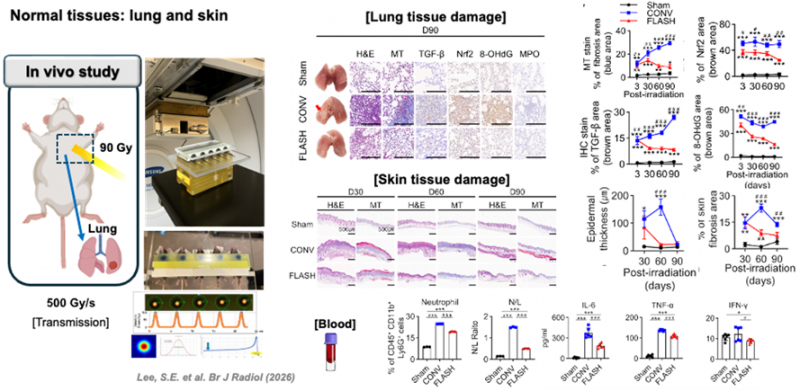
Objectives: FLASH radiotherapy (FLASH-RT), characterized by ultra-high dose rate irradiation (>40 Gy/s), has demonstrated the potential to spare normal tissues while maintaining tumour control. Most proton and electron FLASH studies have focused on whole-organ irradiation, and the normal tissue-sparing effects of high-dose proton FLASH-RT in localized thoracic settings remain unclear.Methods: A preclinical mouse model was developed to evaluate localized high-dose (60 Gy) proton FLASH irradiation to the left lung using spot-size transmission at FLASH (500 Gy/s) or conventional (2 Gy/s) dose rates. Lung and skin responses were assessed by histology, flow cytometry, and enzyme-linked immunosorbent assays.
Results: FLASH-irradiated lungs exhibited decreased pneumonitis and fibrosis compared to conventional irradiation, with faster resolution of tissue damage. Skin toxicity, including epidermal thickening and dermal fibrosis, was significantly reduced after FLASH-RT. At the molecular level, FLASH-RT reduced oxidative stress and inflammatory injury, demonstrated by lower Nrf2 activation, reduced 8-OHdG levels, and decreased MPO expression. Systemically, FLASH-RT led to lower neutrophil-to-lymphocyte ratios and decreased serum IL-6, TNF-α, and IFN-γ, indicating reduced inflammation.
Conclusions: Our findings provide the first evidence that proton FLASH-RT at ablative dose levels (>60 Gy) confers localized protection against radiation-induced lung and skin injury in a preclinical setting. These results support the potential of high-dose proton FLASH-RT for thoracic application, though further studies are needed to establish dose-response relationships and optimize clinical beam configurations.
Advances in knowledge: High-dose proton FLASH-RT preserves lung and skin, and mitigates oxidative and inflammatory responses, offering insights into mechanisms underlying the FLASH effect.
Affiliations
Sung Eun Lee 1, Heesoon Sheen 1, Yeeun Kim 1, Sungkoo Cho 1, Sung Hwan Ahn 1, Kenzo Sasai 2, Nagaaki Kamiguchi 2, Junichi Inoue 2, Daizo Amano 2, Hee Chul Park 3, Youngyih Han 3 4, Changhoon Choi 1
1Department of Radiation Oncology, Samsung Medical Center, Seoul 06351, Republic of Korea.
2Sumitomo Heavy Industries, Ltd, ThinkPark Tower, Tokyo 141-6025, Japan.
3Department of Radiation Oncology, Samsung Medical Center, Sungkyunkwan University School of Medicine, Seoul 06351, Republic of Korea.
4Department of Health Sciences and Technology, SAIHST, Sungkyunkwan University, Seoul 06351, Republic of Korea.
- 키워드
- FLASH; lung injury; proton therapy; skin injury; systemic inflammation.
- 연구소개
- 초고선량률 방사선 치료는 여러 전임상 연구에서 동등한 종양 억제 효과 대비 뛰어난 정상 조직 보호 효과 (FLASH 효과)로 미래의 방사선 암치료법으로 큰 관심을 받고 있다. 본 연구는 마우스 모델에서 500 Gy/s 의 초고선량률 양성자빔을 왼쪽 폐에 90 Gy를 국소조사한 뒤 폐와 피부 조직에서 염증 반응, 산화적 스트레스와 섬유화 정도를 정량화 하였고, 혈액 내 염증 관련 인자들을 분석하여 기존 치료 대비 뚜렷한 정상 조직 보호 효과를 확인하였다. 환자 치료용 양성자빔의 고선량 조건에서의 FLASH 효과를 입증함으로써 향후 임상 시험에 필요한 근거를 제공하였다.
- 덧글달기
- 이전글 [Int J Radiat Biol .] Growth and biological responses of soybean cultivars to gamma-ray and electron beam irradiation
- 다음글 [Biomed Pharmacother .] Association of statin use with attenuated radiation-induced intestinal injury and matrix metalloproteinase-9 modulation: Preclinical and clinical evidence



편집위원
본 연구는 고선량(60 Gy) proton FLASH-RT는 국소 폐 조사에서도 정상 조직(폐·피부)을 유의하게 보호한다는 최초의 직접적 증거를 제시하였고, FLASH 효과가 단순 조직 보호가 아니라, “전신 염증 반응까지 억제”한다는 점이 매우 흥미로움.
덧글달기닫기2026-05-06 18:40:51
등록