
글로벌 연구동향
의학물리학


 2026년 08월호
[J Appl Clin Med Phys .] The illusory correlation between geometrical similarity and physician satisfaction in heart auto-segmentation revealed by a physician-blind test심장 자동분할에서 기하학적 유사도와 physician satisfaction 간의 착시적 상관관계: physician-블라인드 테스트를 통한 규명고려의대 / 이재춘, 허은정, 이석*
- 출처
- J Appl Clin Med Phys .
- 등재일
- 2026 Jun
- 저널이슈번호
- 27(6):e70642.
- 내용
-
Abstract
Background: Auto-segmentation tools are essential in adaptive radiation therapy (ART). While evaluation typically relies on geometric metrics like Dice similarity coefficient (DSC), high scores do not always translate to clinical acceptability.Purpose: This study investigated the "illusory correlation" between geometric indices and physician satisfaction and aimed to identify critical anatomical substructures that dictate clinical judgment.
Methods: Heart auto-segmentation was performed for 30 left-sided breast cancer patients using pre-built and on-site trained fully convolutional dense network (FCDN) models. Geometric similarity was assessed via DSC, mean surface distance (MSD), and 95th percentile Hausdorff Distance (HD95). Clinical satisfaction was quantified through a physician-blind test involving 17 anatomical items. Pearson correlation coefficients (PCC) and conditional probability (P(B|A)) were used to analyze the relationship between substructure accuracy and overall clinical acceptance.
Results: Both models showed high geometric similarity (mean DSC ∼ 0.95), but clinical satisfaction differed drastically: the pre-built model had a 3.3% acceptance rate, while the on-site model achieved 93.3%. PCC analysis failed to show significant correlations between geometric metrics and satisfaction after multiple testing corrections. However, conditional probability analysis revealed that the cranial/caudal borders and the superior vena cava (SVC) were the primary determinants of satisfaction, with P(B|A) values up to 0.95. Conversely, while coronary arteries showed the greatest geometric improvement in the on-site model, their individual success did not guarantee overall clinical acceptance (P(B|A) ∼ 0.42-0.52), explaining the disconnect between standard metrics and clinical judgment.
Conclusions: Geometric metrics alone are insufficient to validate auto-segmentation for clinical use. Clinical acceptance is driven by specific critical substructures, particularly boundary regions, rather than global volumetric similarity. We propose a "two-guideline strategy" that prioritizes these high-impact regions and establishes quantitative gateways for model commissioning, providing a more robust framework for quality assurance (QA) in ART.
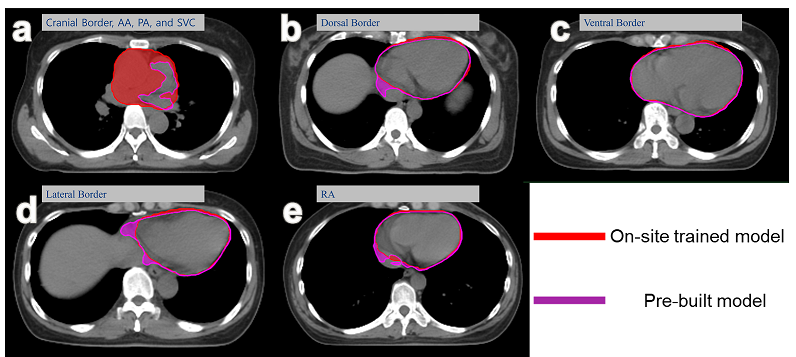
상용 사전 구축 모델과 기관 데이터로 학습한 현장 학습 모델의 심장 자동분할 결과를 비교하여, 전체적인 기하학적 유사도는 비슷하더라도 cardiac border와 great vessels의 세부 윤곽의 차이가 임상적 수용성에 영향을 미침을 확인하였습니다.
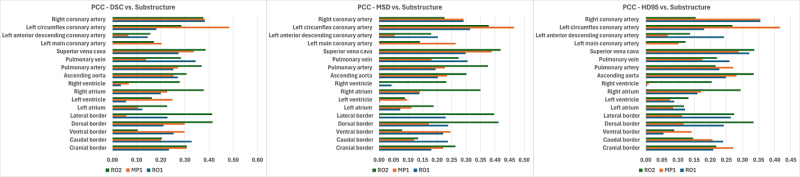
DSC, MSD, HD95와 의료진의 cardiac borders, chambers, great vessels 및 coronary arteries별 임상적 평가 간 상관 정도가 서로 다르게 나타나, 전체 기하학적 지표만으로는 세부 해부학적 영역의 임상적 수용성을 충분히 반영하기 어려움을 확인하였습니다.
Affiliations
Jae Choon Lee 1 2, Eun Jeong Heo 1 3, Song Heui Cho 1, Dong Yun Lee 4, Kyung Hwan Chang 5, Jang Bo Shim 2 6, Nam Kwon Lee 1, Suk Lee 1
1Department of Radiation Oncology, College of Medicine, Korea University, Seoul, Republic of Korea.
2Department of Medical Physics, Kyonggi University, Gyeonggi, Republic of Korea.
3Department of Medical Physics, Graduate School of Korea University, Sejong-si, Chungcheongnam-do, Republic of Korea.
4Department of Sales and CS, OncoSoft, Seoul, Republic of Korea.
5Department of Radiologic Science, Far East University, Eumseong-gun, Chungcheongbuk-do, Republic of Korea.
6Department of Radiation Oncology, Guro Hospital, Korea University Medical Center, Seoul, Republic of Korea.
- 키워드
- adaptive radiation therapy (ART); auto‐segmentation; geometric similarity index; physician satisfaction; physician‐blind test.
- 연구소개
- 인공지능 기반 자동분할 모델은 방사선치료 계획과 적응방사선치료의 핵심 기술이지만, Dice similarity coefficient(DSC)와 같은 기하학적 지표가 높더라도 의료진이 실제 임상에서 수정 없이 사용할 수 있는 윤곽과 반드시 일치하지는 않습니다. 본 연구에서는 심장 자동분할의 기하학적 정확도와 임상적 수용성 간의 관계를 평가하였습니다. 좌측 유방암 환자 30명을 대상으로 상용화 모델과 기관 데이터로 학습한 모델의 심장 자동분할 결과를 비교하였습니다. DSC, MSD, HD95를 산출하고, borders·chambers·great vessels·coronary arteries으로 구성된 17개 항목의 구조화된 의료진 블라인드 평가와 조건부확률 분석을 수행하였습니다. 두 모델 모두 평균 DSC가 약 0.95로 유사했지만, 전체 임상적 수용률은 사전 구축 모델 3.3%, 현장 학습 모델 93.3%로 큰 차이를 보였습니다. 특히 심장의 cranial·caudal border와 superior vena cava (SVC) 등 특정 해부학적 영역의 정확성이 전체 임상적 수용성을 결정하는 주요 요인으로 확인되었습니다. 본 연구는 자동분할 모델의 임상 적용 가능성을 기하학적 지표만으로 판단하는 데 한계가 있음을 보여주었습니다. 또한 임상적으로 중요한 해부학적 영역을 우선 평가하는 구조화된 블라인드 평가체계를 제시함으로써, 향후 의료기관별 인공지능 자동분할 모델의 도입 평가와 품질관리에 활용할 수 있는 근거를 마련하였습니다.
- 덧글달기