
글로벌 연구동향
의학물리학


 2026년 08월호
[Phys Med Biol .] A proof-of-concept automated method for accurate skin dosimetry: correcting overestimated surface dose measurements연세의대 / 박예인, 김진성*, 홍채선*
- 출처
- Phys Med Biol .
- 등재일
- 2026 Jun 16
- 저널이슈번호
- 71(12).
- 내용
Abstract
Objective.Accurate surface dosimetry is recommended for detecting treatment error and managing skin toxicity. However, measurements using detectors such as optically stimulated luminescence dosimeters (OSLDs) may overestimate surface dose in the buildup region due to detector thickness. We developed a new automated framework to overcome these challenges and enhance dose correction accuracy.Approach.The proposed framework includes: (i) determining the detector's position and orientation on the patient's curved surface; (ii) calculating the beam incidence angle for each detector across all radiation beams using treatment planning data and the orientation of the detector; (iii) assessing detector placement relative to the radiation field, and the alignment within irregular subfield areas; (iv) computing the cumulative field contributions to the detector response across all fields; and (v) applying the detector correction factor, defined as the ratio of surface film measurements to detector readings, while considering beam incidence angle and field size. To demonstrate the proof-of-concept of the developed framework, it was evaluated across four treatment modalities using two OSLD types, nanoDot and myOSLchip. Performance was assessed by comparing the OSLD-measured surface dose with the framework-corrected surface dose.Main results.The framework effectively corrected OSLD response to reference skin dose, thereby enhancing the accuracy of skin dose estimation. In the anthropomorphic phantom study, the deviation of OSLD response from skin dose varied up to 21.48% for nanoDot and 46.63% for myOSLchip. With the proposed framework, the deviation was reduced to within 5% across all treatment modalities for both OSLD types, demonstrating a substantial improvement in measurement accuracy.Significance.This novel framework automates the correction of complex factors affecting surface dosimetry, mitigating measurement variability and improving accuracy and consistency. Its feasibility was demonstrated in a phantom-based, preclinical evaluation using breast radiotherapy treatment plans.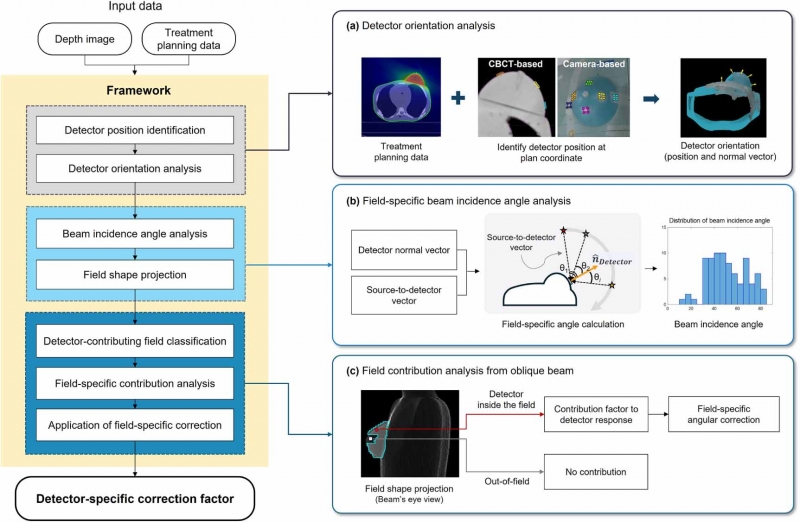
Affiliations
Ye-In Park 1, Hojae Kim 2, Se Young Kim 2, Junyoung Son 3, Changhwan Kim 1, Min Cheol Han 1, Hojin Kim 1, Ho Lee 1, Kwang Woo Park 3, Dong Wook Kim 1, Jin Sung Kim 1, Chae-Seon Hong 1
1Department of Radiation Oncology, Yonsei Cancer Center, Heavy Ion Therapy Research Institute, Yonsei University College of Medicine, Seoul, Republic of Korea.
2Department of Radiation Oncology, Yonsei Cancer Center, Yonsei University Health System, Seoul, Republic of Korea.
3Department of Radiation Oncology, Yongin Severance Hospital, Yonsei University College of Medicine, Yongin, Gyeonggi-do, Republic of Korea.
- 키워드
- angular dependence; detector; film dosimeter; optically stimulated luminescence dosimeter; radiation therapy; skin dose; surface dosimetry
- 연구소개
- 방사선치료 중 피부선량의 정확한 평가는 치료 오류 확인과 피부 부작용 관리에 중요합니다. 본 연구에서는 OSLD의 위치와 방향, 빔 입사각, 조사야 조건을 반영해 측정값의 과대평가를 자동 보정하는 프레임워크를 개발하였습니다. 인체모형 팬텀 평가에서 보정 전 최대 오차는 nanoDot 21.48%, myOSLchip 46.63%였습니다. 제안한 보정 후에는 모든 치료기법에서 오차가 5% 이내로 감소하였습니다. 이 기술은 OSLD 기반 피부선량 측정의 정확성과 일관성을 높일 수 있습니다.
- 덧글달기
- 이전글 [J Appl Clin Med Phys .] Quantitative assessment of CBCT image quality metrics and their translation to clinical Art workflow performance in breast cancer patients
- 다음글 [Med Phys .] Development and validation of an automated, accurate in-house treatment planning system for pencil-beam scanning carbon ion radiotherapy