
글로벌 연구동향
방사선종양학


 2026년 09월호
[Clin Transl Radiat Oncol .] Impact of salvage treatment for recurrent medulloblastoma in previously irradiated patients (KROG 23-02): A multi-institutional retrospective study서울의대 / 전석주, 이주호*
- 출처
- Clin Transl Radiat Oncol .
- 등재일
- 2026 May 26:59:101197.
- 저널이슈번호
- 내용
Abstract
Background: Despite intensified frontline therapy for medulloblastoma, 20-30% of patients still experience disease failure. Outcomes for recurrent disease remain poor, largely due to the lack of standardized salvage strategies. This study evaluated treatment patterns and outcomes of salvage therapy in recurrent or progressive medulloblastoma.Methods: Patients aged ≤ 21 years with histologically confirmed medulloblastoma diagnosed between 2000 and 2020 were analyzed. Inclusion criteria required prior surgery or biopsy followed by postoperative radiotherapy and completion of initial therapy. Disease recurrence or progression was confirmed by MRI and clinical assessment. Local control treatment (LCT) was defined as salvage radiotherapy or surgery. Primary endpoints were progression-free survival (PFS) and overall survival (OS) from initial recurrence.
Results: Seventy-six patients from five centers were included. The median time to first failure was 23.9 months (IQR, 14.9-36.2). Salvage treatments included chemotherapy alone (n = 26), LCT alone (n = 11), and combined LCT and chemotherapy (n = 30); 9 patients received best supportive care. The 1- and 3-year PFS rates were 47.4% and 7.2%, while OS rates were 81.1% and 42.8%, respectively. In univariate analysis, MYCN non-amplification, chemotherapy, and LCT were associated with improved PFS. In multivariate analysis, both chemotherapy (HR, 0.39; p = 0.003) and LCT (HR, 0.51; p = 0.013) remained significant prognostic factors for PFS. For OS, focal relapse and chemotherapy were associated with improved survival.
Conclusions: Outcomes for recurrent medulloblastoma remain unfavorable. However, LCT was associated with improved PFS, while chemotherapy was associated with both improved PFS and OS.
Affiliations
Seok-Joo Chun 1, Nalee Kim 2, Do Hoon Lim 2, Joo-Young Kim 3, Chan Woo Wee 4 5, Hong In Yoon 4 5, Seung Hyuck Jeon 6, In Ah Kim 6, Joo Ho Lee 7 8 9
1Department of Radiation Oncology, Ilsan Dongguk University Hospital, Goyang, the Republic of Korea.
2Department of Radiation Oncology, Samsung Medical Center, Sungkyunkwan University School of Medicine, Seoul, the Republic of Korea.
3Proton Therapy Center, Research Institute and Hospital, National Cancer Center, Goyang, the Republic of Korea.
4Department of Radiation Oncology, Yonsei Cancer Center, Heavy Ion Therapy Research Institute, Yonsei University College of Medicine, Seoul, the Republic of Korea.
5Brain Research Institute, Yonsei University College of Medicine, Seoul, the Republic of Korea.
6Department of Radiation Oncology, Seoul National University Bundang Hospital, Seongnam, the Republic of Korea.
7Department of Radiation Oncology, Seoul National University College of Medicine, Seoul National University Hospital, Seoul, the Republic of Korea.
8Cancer Research Institute, Seoul National University College of Medicine, Seoul, the Republic of Korea.
9Institute of Radiation Medicine, Medical Research Center, Seoul National University College of Medicine, Seoul, the Republic of Korea.
- 키워드
- Chemotherapy; Medulloblastoma; Radiotherapy; Recurrence; Salvage; Surgery.
- 연구소개
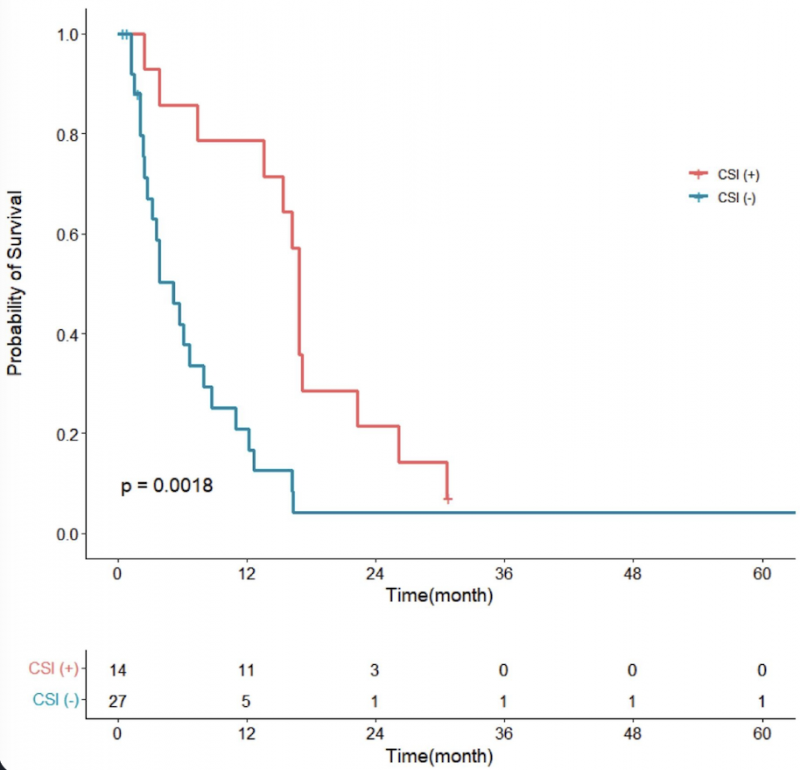
- 이전에 방사선치료를 받은 소아·청소년 재발성 수모세포종 환자 76명을 대상으로 5개 기관에서 시행한 다기관 후향적 연구임. 재발 후 항암화학요법과 국소 치료 (LCT) 모두 PFS 개선과 유의하게 연관되었고, OS 개선에는 국소 재발과 항암화학요법이 유의한 예후인자로 나타남. 특히 미만성 재발 환자에서는 전뇌척수 재조사를 포함한 치료가 PFS를 유의하게 개선시켰음. Re-RT 자체는 3등급 이상 독성이 17.4%에 그쳐 현대적 방사선 기술을 이용하면 비교적 안전하게 시행 가능한 것으로 확인되었음. 재발 수모세포종의 예후는 여전히 불량하지만, 항암화학요법과 국소치료를 결합한 적극적인 다학제 구제치료가 생존율 향상에 기여할 수 있다는 것이 이 연구의 결론임.
- 덧글달기