
글로벌 연구동향
방사선종양학


 2026년 08월호
[ESMO Open .] Optimal clinicogenetic criteria for post-operative re-irradiation in recurrent glioblastoma: KROG 21-02재발성 교모세포종에서 수술 후 재방사선치료를 위한 최적의 임상·유전학적 선별 기준: KROG 21-02연세의대, 서울의대 / 박상준, 김도욱, 위찬우*, 김인아*,
- 출처
- ESMO Open .
- 등재일
- 2026 Jun
- 저널이슈번호
- 11(6):107730.
- 내용
-
Abstract
Background: Patients with glioblastoma (GBM) often have disease progression after standard temozolomide-based chemoradiation. The benefits and optimal use of re-irradiation (re-RT) following re-operation (re-OP) in recurrent GBM (rGBM) remain uncertain. In this study, we assessed the efficacy and safety of post-operative re-RT in patients with isocitrate dehydrogenase-wild-type rGBM, aiming to identify survival benefits and determine clinicogenetic criteria for patient selection.Patients and methods: Data from the Korean Radiation Oncology Group 21-02 retrospective study were evaluated, including 531 patients with rGBM from 2013 to 2019. A subset of 164 patients undergoing re-OP were analyzed for survival and benefits of post-operative re-RT. Additionally, 206 patients receiving re-RT, irrespective of re-OP, were evaluated for risks of radiation necrosis. The overall survival (OS) after re-OP was the primary endpoint. Statistical analyses included the Kaplan-Meier method and log-rank test for OS, Cox proportional hazards regression model for univariate and multivariate analyses, and the Fine-Gray competing risk model for assessing the risk of brain necrosis.
Results: The median OS after re-OP was 13.4 months. Kaplan-Meier analysis revealed significantly better OS for those who received re-RT (17.6 months) than for those who did not (11.0 months; P = 0.002). Factors associated with improved OS included higher Karnofsky performance status scores, post-operative re-RT, and additional systemic therapy after re-OP. Factors associated with adverse outcomes included recurrence outside the initial RT field and homozygous deletion of CDKN2A/B. The incidence of grade 2 or higher RT necrosis was 5.8% among those undergoing both re-OP and post-operative re-RT.
Conclusion: Post-operative re-RT appears to be associated with enhanced survival and minimal toxicity in patients with rGBM following temozolomide chemoradiation. Our study suggests a novel clinicogenetic criterion for re-RT after re-OP in rGBM, which requires further validation.
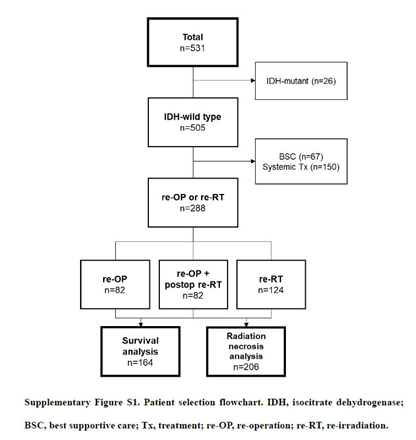
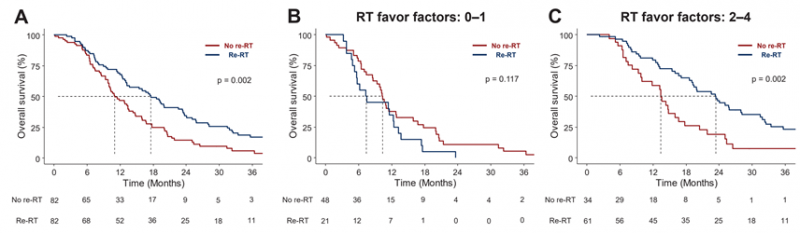
그림 재발성 교모세포종에서 재수술 후 재방사선치료에 따른 전체생존율. 전체 환자에서 수술 후 재방사선치료는 생존기간 연장과 연관되었으며(A), 임상·유전학적 선호 요인을 2개 이상 가진 환자군에서 그 이득이 특히 뚜렷하게 나타났다(C).
Affiliations
S Park 1, D Kim 2, H I Yoon 3, J H Lee 4, D H Lim 5, N Kim 5, J H Song 6, C-O Suh 7, C W Wee 8, I A Kim 9
1Department of Radiation Oncology, Yonsei Cancer Center, Heavy Ion Therapy Research Institute, Yonsei University College of Medicine, Seoul, Korea; Institute for Innovation in Digital Healthcare, Yonsei University, Seoul, Korea.
2Department of Radiation Oncology, Seoul National University College of Medicine, Seoul, Korea; Department of Radiation Oncology, Chungnam National University Hospital, Daejeon, Korea.
3Department of Radiation Oncology, Yonsei Cancer Center, Heavy Ion Therapy Research Institute, Yonsei University College of Medicine, Seoul, Korea; Brain Research Institute, Yonsei University College of Medicine, Seoul, Korea.
4Department of Radiation Oncology, Seoul National University College of Medicine, Seoul, Korea; Department of Radiation Oncology, Seoul National University Hospital, Seoul, Korea.
5Department of Radiation Oncology, Samsung Medical Center, Sungkyunkwan University School of Medicine, Seoul, Korea.
6Department of Radiation Oncology, Seoul St. Mary's Hospital, College of Medicine, The Catholic University, Seoul, Korea.
7Department of Radiation Oncology, Bundang CHA Medical Center, CHA University, Seongnam, Korea.
8Department of Radiation Oncology, Yonsei Cancer Center, Heavy Ion Therapy Research Institute, Yonsei University College of Medicine, Seoul, Korea; Brain Research Institute, Yonsei University College of Medicine, Seoul, Korea. Electronic address: wcw0108@yuhs.ac.
9Department of Radiation Oncology, Seoul National University College of Medicine, Seoul, Korea; Department of Radiation Oncology, Seoul National University Bundang Hospital, Seongnam, Korea. Electronic address: inah228@snu.ac.kr
- 키워드
- biomarker; radiation necrosis; radiotherapy; re-irradiation; recurrent glioblastoma.
- 연구소개
- 교모세포종은 표준 항암방사선치료 후에도 재발이 흔하지만, 재수술 후 재방사선치료의 효과와 적절한 대상자 선정 기준은 명확하지 않습니다. 본 연구에서는 KROG 21-02 다기관 자료를 이용하여 재발성 IDH-wild-type 교모세포종 환자에서 수술 후 재방사선치료의 효과와 안전성을 평가하고, 치료 이득을 예측할 수 있는 임상·유전학적 요인을 분석하였습니다. 재수술을 받은 164명의 환자 중 수술 후 재방사선치료를 받은 환자의 중앙 전체생존기간은 17.6개월로, 재방사선치료를 받지 않은 환자의 11.0개월보다 유의하게 길었습니다. 또한 재발까지의 기간, 수행능력, TERT promoter 변이 및 CDKN2A/B 동형접합 결실을 바탕으로, 재방사선치료의 이득이 클 가능성이 있는 환자군을 탐색적으로 제시하였습니다.
- 덧글달기
- 이전글 [Cancer Res Treat .] Effectiveness of Radiotherapy for Hepatocellular Carcinoma with Lymph Node Metastasis: A Meta-Analysis
- 다음글 [Int J Radiat Biol .] Changes of F-18 fluorodeoxyglucose positron emission tomography/computed tomography textural features in temporal lobe after radiotherapy for nasopharyngeal carcinoma



편집위원
교모세포종으로 수술과 방사선치료 이후에 재발하여 다시 수술과 방사선 치료를 받은 환자들을 후향적으로 분석한 KROG 논문으로, 다양한 임상 유전학적 인자들이 예후에 미치는 영향을 분석함.
덧글달기닫기2026-07-21 10:39:20
등록
편집위원2
재발성 교모세포종에서 re-operation 혹은 re-irradiation을 받은 환자들의 특성을 분석함으로써 re-operation에 따른 생존율과 re-irradiation에 따른 radiation necrosis의 위험성에 대한 여러 임상 인자들을 제시하여 이러한 환자들에서 최선의 치료를 결정하기 위한 근거를 제시한 흥미로운 연구입니다.
덧글달기닫기2026-07-21 10:43:18
등록
편집위원3
최근 관심이 증대되고있는 Re-RT의 효과에 대한 연구로서 GBM 환자에 대한 Post-operative re-RT가 상대적으로 OS가 우수하고 작은 부작용을 가진다는 것을 보여줌
덧글달기닫기2026-07-22 14:36:43
등록
편집위원 4
본 연구는 표준 테모졸로마이드 기반 화학방사선치료 후 재발한 IDH 야생형 교모세포종 환자에서 재수술 후 재방사선치료의 효과와 안전성을 평가한 다기관 후향적 연구임. Korean Radiation Oncology Group 21-02 연구에 등록된 재발 교모세포종 환자 531명 중 재수술을 받은 164명을 대상으로 생존 결과를 분석하고, 재방사선치료를 받은 206명에서 방사선괴사 위험을 평가함. 연구 결과, 재수술 후 재방사선치료를 받은 환자군의 중앙 전체생존기간은 17.6개월로, 재방사선치료를 받지 않은 환자군의 11.0개월보다 유의하게 길었음. 높은 Karnofsky 수행상태 점수, 재방사선치료 및 추가 전신치료는 생존 향상과 관련된 반면, 최초 방사선 조사 범위 밖의 재발과 CDKN2A/B 동형접합 결실은 불량한 예후와 관련됨. 또한 재수술 후 재방사선치료를 받은 환자에서 2등급 이상의 방사선괴사 발생률은 5.8%로 비교적 낮았음. 본 연구는 재발 교모세포종에서 재수술 후 재방사선치료가 생존 연장에 기여할 수 있으며, 수행상태, 재발 위치 및 CDKN2A/B 결실을 고려한 임상·유전학적 환자 선별이 중요함을 시사함.
덧글달기닫기2026-07-22 14:41:45
등록